
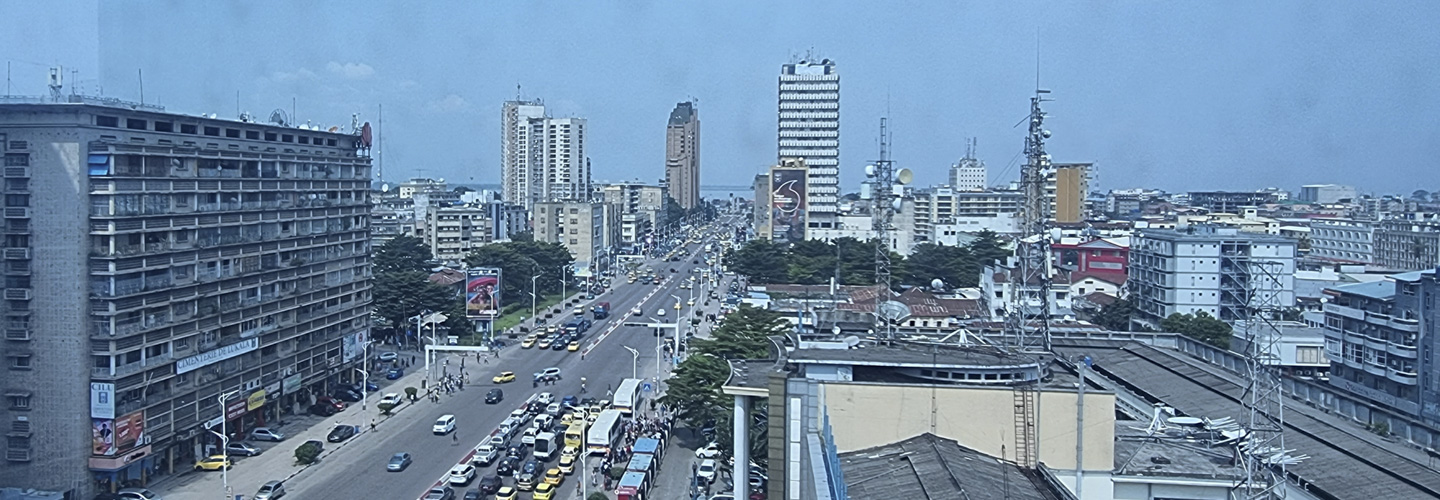
IMF’s recent engagements on infrastructure governance
| Public Investment Management Assessment (PIMA) | February 2022 |
| Climate PIMA (C-PIMA) | February 2022 |
Summary of PIMA report
(Published in April 2022)
Despite some recovery in the 2000s, the levels of public investment in the DRC remain well below the average for comparator countries. Investment by general government, financed to a large part by external resources, has fluctuated around 4 percent of GDP since 2003, remaining almost 50 percent lower than the averages for Sub-Saharan African countries and for low-income countries. This enabled the rebuilding of part of the stock of public capital (46 percent of GDP in 2019), but the stock of capital per capita continues to be among the lowest in the world (≈ US$200 in 2019). In addition, there are investments carried out by public corporations in the energy and mining sectors (≈ 2 percentage points of GDP a year in recent years), as well as by the public-private partnerships (PPPs) in the transport sector (stock of at least 4 percent of GDP).
⚠ Some users may experience reduced functionality using Internet Explorer. For the optimal experience, use Chrome or another alternative browser.
- Chart View: Institutional Design vs. Effectiveness
- Chart View: Comparison with Peers
- Learn how to interpret the flower chart
PHASES
Planning (Institutions 1-5) Allocation (Institutions 6-10) Implementation (Institutions 11-15)
Loading...
INSTITUTION
1. Fiscal Targets and Rules
SUMMARY ASSESSMENT
Institutional Design: ---
Effectiveness: ---
OVERALL SCORES
Loading...
DIMENSION SCORES
1.a. Is there a target or limit for government to ensure debt sustainability?
Loading...
1.b. Is fiscal policy guided by one or more permanent fiscal rules?
Loading...
1.c. Is there a medium-term fiscal framework (MTFF) to align budget preparation with fiscal policy?
Loading...
INSTITUTION
2. National and Sectoral Planning
SUMMARY ASSESSMENT
Institutional Design: ---
Effectiveness: ---
OVERALL SCORES
Loading...
DIMENSION SCORES
2.a. Does the government prepare national and sectoral strategies for public investment?
Loading...
2.b. Are the government’s national and sectoral strategies or plans for public investment costed?
Loading...
2.c. Do sector strategies include measurable targets for the outputs and outcomes of investment projects?
Loading...
INSTITUTION
3. Coordinating Between Entities
SUMMARY ASSESSMENT
Institutional Design: ---
Effectiveness: ---
OVERALL SCORES
Loading...
DIMENSION SCORES
3.a. Is capital spending by SNGs, coordinated with the central government?
Loading...
3.b. Does the central government have a transparent, rule-based system for making capital transfers to SNGs, and for providing timely information on such transfers?
Loading...
3.c. Are contingent liabilities arising from capital projects of SNGs, PCs, and PPPs reported to the central government?
Loading...
INSTITUTION
4. Project Appraisal
SUMMARY ASSESSMENT
Institutional Design: ---
Effectiveness: ---
OVERALL SCORES
Loading...
DIMENSION SCORES
4.a. Are major capital projects subject to rigorous technical, economic, and financial analysis?
Loading...
4.b. Is there a standard methodology and central support for the appraisal of projects?
Loading...
4.c. Are risks taken into account in conducting project appraisals?
Loading...
INSTITUTION
5. Alternative Infrastructure Financing
SUMMARY ASSESSMENT
Institutional Design: ---
Effectiveness: ---
OVERALL SCORES
Loading...
DIMENSION SCORES
5.a. Does the regulatory framework support competition in contestable markets for economic infrastructure (e.g., power, water, telecoms, and transport)?
Loading...
5.b. Has the government published a strategy/policy for PPPs, and a legal/regulatory framework which guides the preparation, selection, and management of PPP projects?
Loading...
5.c. Does the government oversee the investment plans of public corporations (PCs) and monitor their financial performance?
Loading...
INSTITUTION
6. Multiyear Budgeting
SUMMARY ASSESSMENT
Institutional Design: ---
Effectiveness: ---
OVERALL SCORES
Loading...
DIMENSION SCORES
6.a. Is capital spending by ministry or sector forecasted over a multiyear horizon?
Loading...
6.b. Are there multiyear ceilings on capital expenditure by ministry, sector, or program?
Loading...
6.c. Are projections of the total construction cost of major capital projects published?
Loading...
INSTITUTION
7. Budget Comprehensiveness and Unity
SUMMARY ASSESSMENT
Institutional Design: ---
Effectiveness: ---
OVERALL SCORES
Loading...
DIMENSION SCORES
7.a. Is capital spending mostly undertaken through the budget?
Loading...
7.b. Are all capital projects, regardless of financing source, shown in the budget documentation?
Loading...
7.c. Are capital and recurrent budgets prepared and presented together in the budget?
Loading...
INSTITUTION
8. Budgeting for Investment
SUMMARY ASSESSMENT
Institutional Design: ---
Effectiveness: ---
OVERALL SCORES
Loading...
DIMENSION SCORES
8.a. Are total project outlays appropriated by the legislature at the time of a project’s commencement?
Loading...
8.b. Are in-year transfers of appropriations (virement) from capital to current spending prevented?
Loading...
8.c. Is the completion of ongoing projects given priority over starting new projects?
Loading...
INSTITUTION
9. Maintenance and Funding
SUMMARY ASSESSMENT
Institutional Design: ---
Effectiveness: ---
OVERALL SCORES
Loading...
DIMENSION SCORES
9.a. Is there a standard methodology for estimating routine maintenance needs and budget funding?
Loading...
9.b. Is there a standard methodology for determining major improvements (e.g. renovations, reconstructions, enlargements) to existing assets, and are they included in national and sectoral investment plans?
Loading...
9.c. Can expenditures relating to routine maintenance and major improvements be identified in the budget?
Loading...
INSTITUTION
10. Project Selection
SUMMARY ASSESSMENT
Institutional Design: ---
Effectiveness: ---
OVERALL SCORES
Loading...
DIMENSION SCORES
10.a. Does the government undertake a central review of major project appraisals before decisions are taken to include projects in the budget?
Loading...
10.b. Does the government publish and adhere to standard criteria, and stipulate a required process for project selection?
Loading...
10.c. Does the government maintain a pipeline of appraised investment projects for inclusion in the annual budget?
Loading...
INSTITUTION
11. Procurement
SUMMARY ASSESSMENT
Institutional Design: ---
Effectiveness: ---
OVERALL SCORES
Loading...
DIMENSION SCORES
11.a. Is the procurement process for major capital projects open and transparent?
Loading...
11.b. Is there a system in place to ensure that procurement is monitored adequately?
Loading...
11.c. Are procurement complaints review process conducted in a fair and timely manner?
Loading...
INSTITUTION
12. Availability of Funding
SUMMARY ASSESSMENT
Institutional Design: ---
Effectiveness: ---
OVERALL SCORES
Loading...
DIMENSION SCORES
12.a. Are ministries/agencies able to plan and commit expenditure on capital projects in advance on the basis of reliable cash-flow forecasts?
Loading...
12.b. Is cash for project outlays released in a timely manner?
Loading...
12.c. Is external (donor) funding of capital projects fully integrated into the main government bank account structure?
Loading...
INSTITUTION
13. Portfolio Management and Oversight
SUMMARY ASSESSMENT
Institutional Design: ---
Effectiveness: ---
OVERALL SCORES
Loading...
DIMENSION SCORES
13.a. Are major capital projects subject to monitoring during project implementation?
Loading...
13.b. Can funds be re-allocated between investment projects during implementation?
Loading...
13.c. Does the government adjust project implementation policies and procedures by systematically conducting ex post reviews of projects that have completed their construction phase?
Loading...
INSTITUTION
14. Management Project Implementation
SUMMARY ASSESSMENT
Institutional Design: ---
Effectiveness: ---
OVERALL SCORES
Loading...
DIMENSION SCORES
14.a. Do ministries/agencies have effective project management arrangements in place?
Loading...
14.b. Has the government issued rules, procedures and guidelines for project adjustments that are applied systematically across all major projects?
Loading...
14.c. Are ex post audits of capital projects routinely undertaken?
Loading...
INSTITUTION
15. Monitoring of Public Assets
SUMMARY ASSESSMENT
Institutional Design: ---
Effectiveness: ---
OVERALL SCORES
Loading...
DIMENSION SCORES
15.a. Are asset registers updated by surveys of the stocks, values, and conditions of public assets regularly?
Loading...
15.b. Are nonfinancial asset values recorded in the government financial accounts?
Loading...
15.c. Is the depreciation of fixed assets captured in the government’s operating statements?
Loading...
PIMA SCORES
Income Groups
Regions
PHASES
Planning (Institutions 1-5) Allocation (Institutions 6-10) Implementation (Institutions 11-15)
Loading...
Loading...
Loading...
Loading...
Sources: IMF Investment and Capital Stock Dataset, 2021; and IMF staff calculations based on PIMA reports. Note: The data displayed above might differ from the data in the PIMA report as the latter might incorporate additional information obtained during the PIMA mission.
INSTITUTION
1. Fiscal Targets and Rules
SUMMARY ASSESSMENT
Institutional Design: ---
Effectiveness: ---
OVERALL SCORES
Loading...
DIMENSION SCORES
1.a. Is there a target or limit for government to ensure debt sustainability?
Loading...
1.b. Is fiscal policy guided by one or more permanent fiscal rules?
Loading...
1.c. Is there a medium-term fiscal framework (MTFF) to align budget preparation with fiscal policy?
Loading...
INSTITUTION
2. National and Sectoral Planning
SUMMARY ASSESSMENT
Institutional Design: ---
Effectiveness: ---
OVERALL SCORES
Loading...
DIMENSION SCORES
2.a. Does the government prepare national and sectoral strategies for public investment?
Loading...
2.b. Are the government’s national and sectoral strategies or plans for public investment costed?
Loading...
2.c. Do sector strategies include measurable targets for the outputs and outcomes of investment projects?
Loading...
INSTITUTION
3. Coordinating Between Entities
SUMMARY ASSESSMENT
Institutional Design: ---
Effectiveness: ---
OVERALL SCORES
Loading...
DIMENSION SCORES
3.a. Is capital spending by SNGs, coordinated with the central government?
Loading...
3.b. Does the central government have a transparent, rule-based system for making capital transfers to SNGs, and for providing timely information on such transfers?
Loading...
3.c. Are contingent liabilities arising from capital projects of SNGs, PCs, and PPPs reported to the central government?
Loading...
INSTITUTION
4. Project Appraisal
SUMMARY ASSESSMENT
Institutional Design: ---
Effectiveness: ---
OVERALL SCORES
Loading...
DIMENSION SCORES
4.a. Are major capital projects subject to rigorous technical, economic, and financial analysis?
Loading...
4.b. Is there a standard methodology and central support for the appraisal of projects?
Loading...
4.c. Are risks taken into account in conducting project appraisals?
Loading...
INSTITUTION
5. Alternative Infrastructure Financing
SUMMARY ASSESSMENT
Institutional Design: ---
Effectiveness: ---
OVERALL SCORES
Loading...
DIMENSION SCORES
5.a. Does the regulatory framework support competition in contestable markets for economic infrastructure (e.g., power, water, telecoms, and transport)?
Loading...
5.b. Has the government published a strategy/policy for PPPs, and a legal/regulatory framework which guides the preparation, selection, and management of PPP projects?
Loading...
5.c. Does the government oversee the investment plans of public corporations (PCs) and monitor their financial performance?
Loading...
INSTITUTION
6. Multiyear Budgeting
SUMMARY ASSESSMENT
Institutional Design: ---
Effectiveness: ---
OVERALL SCORES
Loading...
DIMENSION SCORES
6.a. Is capital spending by ministry or sector forecasted over a multiyear horizon?
Loading...
6.b. Are there multiyear ceilings on capital expenditure by ministry, sector, or program?
Loading...
6.c. Are projections of the total construction cost of major capital projects published?
Loading...
INSTITUTION
7. Budget Comprehensiveness and Unity
SUMMARY ASSESSMENT
Institutional Design: ---
Effectiveness: ---
OVERALL SCORES
Loading...
DIMENSION SCORES
7.a. Is capital spending mostly undertaken through the budget?
Loading...
7.b. Are all capital projects, regardless of financing source, shown in the budget documentation?
Loading...
7.c. Are capital and recurrent budgets prepared and presented together in the budget?
Loading...
INSTITUTION
8. Budgeting for Investment
SUMMARY ASSESSMENT
Institutional Design: ---
Effectiveness: ---
OVERALL SCORES
Loading...
DIMENSION SCORES
8.a. Are total project outlays appropriated by the legislature at the time of a project’s commencement?
Loading...
8.b. Are in-year transfers of appropriations (virement) from capital to current spending prevented?
Loading...
8.c. Is the completion of ongoing projects given priority over starting new projects?
Loading...
INSTITUTION
9. Maintenance and Funding
SUMMARY ASSESSMENT
Institutional Design: ---
Effectiveness: ---
OVERALL SCORES
Loading...
DIMENSION SCORES
9.a. Is there a standard methodology for estimating routine maintenance needs and budget funding?
Loading...
9.b. Is there a standard methodology for determining major improvements (e.g. renovations, reconstructions, enlargements) to existing assets, and are they included in national and sectoral investment plans?
Loading...
9.c. Can expenditures relating to routine maintenance and major improvements be identified in the budget?
Loading...
INSTITUTION
10. Project Selection
SUMMARY ASSESSMENT
Institutional Design: ---
Effectiveness: ---
OVERALL SCORES
Loading...
DIMENSION SCORES
10.a. Does the government undertake a central review of major project appraisals before decisions are taken to include projects in the budget?
Loading...
10.b. Does the government publish and adhere to standard criteria, and stipulate a required process for project selection?
Loading...
10.c. Does the government maintain a pipeline of appraised investment projects for inclusion in the annual budget?
Loading...
INSTITUTION
11. Procurement
SUMMARY ASSESSMENT
Institutional Design: ---
Effectiveness: ---
OVERALL SCORES
Loading...
DIMENSION SCORES
11.a. Is the procurement process for major capital projects open and transparent?
Loading...
11.b. Is there a system in place to ensure that procurement is monitored adequately?
Loading...
11.c. Are procurement complaints review process conducted in a fair and timely manner?
Loading...
INSTITUTION
12. Availability of Funding
SUMMARY ASSESSMENT
Institutional Design: ---
Effectiveness: ---
OVERALL SCORES
Loading...
DIMENSION SCORES
12.a. Are ministries/agencies able to plan and commit expenditure on capital projects in advance on the basis of reliable cash-flow forecasts?
Loading...
12.b. Is cash for project outlays released in a timely manner?
Loading...
12.c. Is external (donor) funding of capital projects fully integrated into the main government bank account structure?
Loading...
INSTITUTION
13. Portfolio Management and Oversight
SUMMARY ASSESSMENT
Institutional Design: ---
Effectiveness: ---
OVERALL SCORES
Loading...
DIMENSION SCORES
13.a. Are major capital projects subject to monitoring during project implementation?
Loading...
13.b. Can funds be re-allocated between investment projects during implementation?
Loading...
13.c. Does the government adjust project implementation policies and procedures by systematically conducting ex post reviews of projects that have completed their construction phase?
Loading...
INSTITUTION
14. Management Project Implementation
SUMMARY ASSESSMENT
Institutional Design: ---
Effectiveness: ---
OVERALL SCORES
Loading...
DIMENSION SCORES
14.a. Do ministries/agencies have effective project management arrangements in place?
Loading...
14.b. Has the government issued rules, procedures and guidelines for project adjustments that are applied systematically across all major projects?
Loading...
14.c. Are ex post audits of capital projects routinely undertaken?
Loading...
INSTITUTION
15. Monitoring of Public Assets
SUMMARY ASSESSMENT
Institutional Design: ---
Effectiveness: ---
OVERALL SCORES
Loading...
DIMENSION SCORES
15.a. Are asset registers updated by surveys of the stocks, values, and conditions of public assets regularly?
Loading...
15.b. Are nonfinancial asset values recorded in the government financial accounts?
Loading...
15.c. Is the depreciation of fixed assets captured in the government’s operating statements?
Loading...
How To Read The Flower Chart
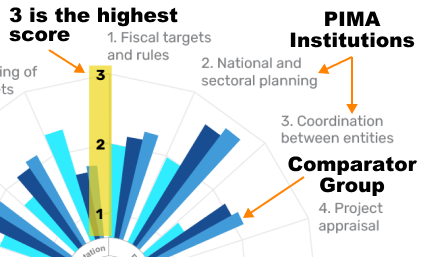 |
Scoring Each institution is analyzed along three dimensions that reflect the key features of the given institution, resulting in a total of 45 dimensions. Three possible scores are assigned to each dimension (1: not met, 2: partially met, 3: fully met) and their average within an institution produces a score for that institution. PIMA scores are summarized in a chart that allows comparison with its comparators. In the chart, the further the away from the center, the higher the PIMA scores.
|
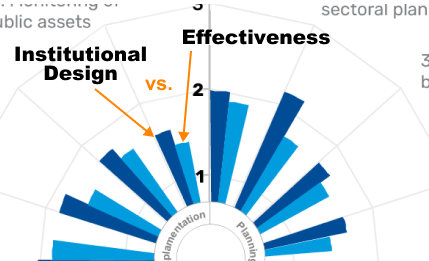 |
Institutional Design and Effectiveness Another key feature of the PIMA is that it assesses both institutional design (“what is on paper”) and effectiveness (“what is in practice”) of a given country, because there is often a gap between the design of formal rules and how they are implemented in practice, due to capacity constraints among others. |
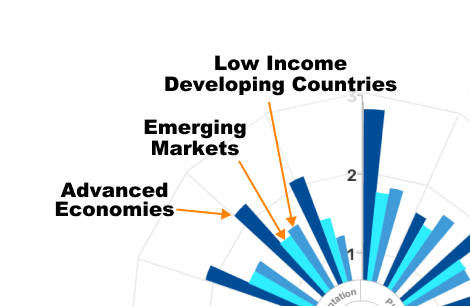 |
Scores by Income Level All countries, most notably emerging markets and low-income developing countries, have significant room to improve their infrastructure governance to increase effectiveness in public investment.
|
What Countries are in Each Income Group
The countries listed below cover only refer to those that have conducted PIMA.
Advanced economies (ADV) and low-income developing countries (LIDC) are classified according to latest World Economic Outlook. Emerging market (EME) include those not classified as advanced economies or low-income developing countries. Fragile states are classified based on IMF Policy Paper, Macroeconomic Developments and Prospects in Low-Income Developing Countries, 2018.
Advanced Economies (ADV)
Estonia Ireland Poland Slovak Republic United Kingdom |
Emerging Markets (EME)
Albania Angola Anguilla Argentina Armenia Belize Bosnia and Herzegovina Botswana Brazil Bulgaria |
Costa Rica Croatia Egypt El Salvador Eswatini Gabon Georgia Grenada Guyana Indonesia |
Jordan Kosovo Lebanon Malaysia Maldives Mauritius Mexico Montenegro Morocco North Macedonia |
Peru Philippines Romania Serbia Sri Lanka Thailand Timor-Leste Tunisia Ukraine |
Low-Income Developing Countries (LIDC)
Bangladesh Benin Burkina Faso Cambodia Cameroon Côte d'Ivoire Democratic Republic of Congo The Gambia Ghana |
Guinea Haiti Honduras Kenya Kiribati Kyrgyz Republic Liberia Madagascar Malawi |
Mali Mauritania Moldova Mongolia Mozambique Nepal Niger Nigeria Rwanda |
Senegal Sierra Leone Togo Uzbekistan Vietnam Zambia |
Fragile States (FS)
Côte d'Ivoire Democratic Republic of Congo Gambia Guinea Haiti Kiribati |
Kosovo Lebanon Liberia Madagascar Malawi Maldives |
Mali Sierra Leone Timor-Leste Togo |
Summary of C-PIMA report
(Published in April 2022)
The DRC is particularly vulnerable to climate change due to its specific geographical characteristics. The annual average temperature has increased by 0.2 degree per decade over the last thirty years and is expected to continue to increase by 1 to 2 degrees 60 by 2050 with a potential rise of 5 degrees by 2100. Although the DRC has exceptional natural resources (river system, arable land, biodiversity, tropical forest, and minerals), it is vulnerable to a very large variety of climate risks, particularly due to its huge land mass (2.4 million km2 ) and the fact that it spans three climate zones (equatorial, tropical, and high-altitude). The main risks attached to climate change are torrential rain, coastal erosion, earthquakes, flooding, heatwaves, and also seasonal drought. The scale of deforestation, combined with periods of heavy rain and with urbanization, also leads to particularly frequent landslides, especially in the Kivu region. The ranking of the DRC (177th out of 181 countries) in relation to the Notre Dame University index, which measures both vulnerability to climate change (degree of exposure, sensitivity, and adaptation ability) for six key sectors and the degree of preparation (economic, institutional, and social), illustrates the magnitude of the challenges ahead. Natural disasters linked to climate change will become more and more frequent in the coming years due to the rise in temperature and precipitation, which will have automatic consequences for health, biodiversity, access to water, agriculture, and employment.
⚠ Some users may experience reduced functionality using Internet Explorer. For the optimal experience, use Chrome or another alternative browser.
- Chart View: Institutional Design
- Chart View: Comparison with Peers
- Learn how to interpret the flower chart
INSTITUTIONS
C1 (Dimensions C1a-C1c) C2 (Dimensions C2a-C2c) C3 (Dimensions C3a-C3c) C4 (Dimensions C4a-C4c) C5 (Dimensions C5a-C5c)
Loading...
DIMENSION
C1a. National and Sectoral Planning
SUMMARY ASSESSMENT
Institutional Design: ---
DIMENSION SCORE
Loading...
DIMENSION SCORES
C1a.a.
Loading...
C1a.b.
Loading...
C1a.c.
Loading...
DIMENSION
C1b. Land Use and Building Regulations
SUMMARY ASSESSMENT
Institutional Design: ---
DIMENSION SCORE
Loading...
DIMENSION SCORES
C1b.a.
Loading...
C1b.b.
Loading...
C1b.c.
Loading...
DIMENSION
C1c. Centralized Guidance on Planning
SUMMARY ASSESSMENT
Institutional Design: ---
DIMENSION SCORE
Loading...
DIMENSION SCORES
C1c.a.
Loading...
C1c.b.
Loading...
C1c.c.
Loading...
DIMENSION
C2a. Coordination Across Central Government
SUMMARY ASSESSMENT
Institutional Design: ---
DIMENSION SCORE
Loading...
DIMENSION SCORES
C2a.a.
Loading...
C2a.b.
Loading...
C2a.c.
Loading...
DIMENSION
C2b. Coordination with Subnational Governments
SUMMARY ASSESSMENT
Institutional Design: ---
DIMENSION SCORE
Loading...
DIMENSION SCORES
C2b.a.
Loading...
C2b.b.
Loading...
C2b.c.
Loading...
DIMENSION
C2c. Oversight Framework for Public Corporations
SUMMARY ASSESSMENT
Institutional Design: ---
DIMENSION SCORE
Loading...
DIMENSION SCORES
C2c.a.
Loading...
C2c.b.
Loading...
C2c.c.
Loading...
DIMENSION
C3a. Climate Analysis in Project Appraisal
SUMMARY ASSESSMENT
Institutional Design: ---
DIMENSION SCORE
Loading...
DIMENSION SCORES
C3a.a.
Loading...
C3a.b.
Loading...
C3a.c.
Loading...
DIMENSION
C3b. PPP Framework Including Climate Risks
SUMMARY ASSESSMENT
Institutional Design: ---
DIMENSION SCORE
Loading...
DIMENSION SCORES
C3b.a.
Loading...
C3b.b.
Loading...
C3b.c.
Loading...
DIMENSION
C3c. Climate Consideration in Project Selection
SUMMARY ASSESSMENT
Institutional Design: ---
DIMENSION SCORE
Loading...
DIMENSION SCORES
C3c.a.
Loading...
C3c.b.
Loading...
C3c.c.
Loading...
DIMENSION
C4a. Climate Budget Tagging
SUMMARY ASSESSMENT
Institutional Design: ---
DIMENSION SCORE
Loading...
DIMENSION SCORES
C4a.a.
Loading...
C4a.b.
Loading...
C4a.c.
Loading...
DIMENSION
C4b. Ex Post Review of Projects
SUMMARY ASSESSMENT
Institutional Design: ---
DIMENSION SCORE
Loading...
DIMENSION SCORES
C4b.a.
Loading...
C4b.b.
Loading...
C4b.c.
Loading...
DIMENSION
C4c. Asset Management Including Climate Risks
SUMMARY ASSESSMENT
Institutional Design: ---
DIMENSION SCORE
Loading...
DIMENSION SCORES
C4c.a.
Loading...
C4c.b.
Loading...
C4c.c.
Loading...
DIMENSION
C5a. Disaster Risk Management Strategy
SUMMARY ASSESSMENT
Institutional Design: ---
DIMENSION SCORE
Loading...
DIMENSION SCORES
C5a.a.
Loading...
C5a.b.
Loading...
C5a.c.
Loading...
DIMENSION
C5b. Ex Ante Financing Mechanisms
SUMMARY ASSESSMENT
Institutional Design: ---
DIMENSION SCORE
Loading...
DIMENSION SCORES
C5b.a.
Loading...
C5b.b.
Loading...
C5b.c.
Loading...
DIMENSION
C5c. Fiscal Risk Analysis Including Climate Risks
SUMMARY ASSESSMENT
Institutional Design: ---
DIMENSION SCORE
Loading...
DIMENSION SCORES
C5c.a.
Loading...
C5c.b.
Loading...
C5c.c.
Loading...
C-PIMA SCORES
Income Groups
Regions
INSTITUTIONS
C1 (Dimensions C1a-C1c) C2 (Dimensions C2a-C2c) C3 (Dimensions C3a-C3c) C4 (Dimensions C4a-C4c) C5 (Dimensions C5a-C5c)
Loading...
Loading...
Loading...
Loading...
Sources: IMF Investment and Capital Stock Dataset, 2021; and IMF staff calculations based on PIMA reports. Note: The data displayed above might differ from the data in the PIMA report as the latter might incorporate additional information obtained during the PIMA mission.
DIMENSION
C1a. National and Sectoral Planning
SUMMARY ASSESSMENT
Institutional Design: ---
DIMENSION SCORE
Loading...
DIMENSION SCORES
C1a.a.
Loading...
C1a.b.
Loading...
C1a.c.
Loading...
DIMENSION
C1b. Land Use and Building Regulations
SUMMARY ASSESSMENT
Institutional Design: ---
DIMENSION SCORE
Loading...
DIMENSION SCORES
C1b.a.
Loading...
C1b.b.
Loading...
C1b.c.
Loading...
DIMENSION
C1c. Centralized Guidance on Planning
SUMMARY ASSESSMENT
Institutional Design: ---
DIMENSION SCORE
Loading...
DIMENSION SCORES
C1c.a.
Loading...
C1c.b.
Loading...
C1c.c.
Loading...
DIMENSION
C2a. Coordination Across Central Government
SUMMARY ASSESSMENT
Institutional Design: ---
DIMENSION SCORE
Loading...
DIMENSION SCORES
C2a.a.
Loading...
C2a.b.
Loading...
C2a.c.
Loading...
DIMENSION
C2b. Coordination with Subnational Governments
SUMMARY ASSESSMENT
Institutional Design: ---
DIMENSION SCORE
Loading...
DIMENSION SCORES
C2b.a.
Loading...
C2b.b.
Loading...
C2b.c.
Loading...
DIMENSION
C2c. Oversight Framework for Public Corporations
SUMMARY ASSESSMENT
Institutional Design: ---
DIMENSION SCORE
Loading...
DIMENSION SCORES
C2c.a.
Loading...
C2c.b.
Loading...
C2c.c.
Loading...
DIMENSION
C3a. Climate Analysis in Project Appraisal
SUMMARY ASSESSMENT
Institutional Design: ---
DIMENSION SCORE
Loading...
DIMENSION SCORES
C3a.a.
Loading...
C3a.b.
Loading...
C3a.c.
Loading...
DIMENSION
C3b. PPP Framework Including Climate Risks
SUMMARY ASSESSMENT
Institutional Design: ---
DIMENSION SCORE
Loading...
DIMENSION SCORES
C3b.a.
Loading...
C3b.b.
Loading...
C3b.c.
Loading...
DIMENSION
C3c. Climate Consideration in Project Selection
SUMMARY ASSESSMENT
Institutional Design: ---
DIMENSION SCORE
Loading...
DIMENSION SCORES
C3c.a.
Loading...
C3c.b.
Loading...
C3c.c.
Loading...
DIMENSION
C4a. Climate Budget Tagging
SUMMARY ASSESSMENT
Institutional Design: ---
DIMENSION SCORE
Loading...
DIMENSION SCORES
C4a.a.
Loading...
C4a.b.
Loading...
C4a.c.
Loading...
DIMENSION
C4b. Ex Post Review of Projects
SUMMARY ASSESSMENT
Institutional Design: ---
DIMENSION SCORE
Loading...
DIMENSION SCORES
C4b.a.
Loading...
C4b.b.
Loading...
C4b.c.
Loading...
DIMENSION
C4c. Asset Management Including Climate Risks
SUMMARY ASSESSMENT
Institutional Design: ---
DIMENSION SCORE
Loading...
DIMENSION SCORES
C4c.a.
Loading...
C4c.b.
Loading...
C4c.c.
Loading...
DIMENSION
C5a. Disaster Risk Management Strategy
SUMMARY ASSESSMENT
Institutional Design: ---
DIMENSION SCORE
Loading...
DIMENSION SCORES
C5a.a.
Loading...
C5a.b.
Loading...
C5a.c.
Loading...
DIMENSION
C5b. Ex Ante Financing Mechanisms
SUMMARY ASSESSMENT
Institutional Design: ---
DIMENSION SCORE
Loading...
DIMENSION SCORES
C5b.a.
Loading...
C5b.b.
Loading...
C5b.c.
Loading...
DIMENSION
C5c. Fiscal Risk Analysis Including Climate Risks
SUMMARY ASSESSMENT
Institutional Design: ---
DIMENSION SCORE
Loading...
DIMENSION SCORES
C5c.a.
Loading...
C5c.b.
Loading...
C5c.c.
Loading...
How To Read The Flower Chart
|
Scoring Each institution is analyzed along three dimensions that reflect the key features of the given institution, resulting in a total of 45 dimensions. Three possible scores are assigned to each dimension (1: not met, 2: partially met, 3: fully met) and their average within an institution produces a score for that institution. PIMA scores are summarized in a chart that allows comparison with its comparators. In the chart, the further the away from the center, the higher the PIMA scores.
|
|
Institutional Design and Effectiveness Another key feature of the PIMA is that it assesses both institutional design (“what is on paper”) and effectiveness (“what is in practice”) of a given country, because there is often a gap between the design of formal rules and how they are implemented in practice, due to capacity constraints among others. |
|
Scores by Income Level All countries, most notably emerging markets and low-income developing countries, have significant room to improve their infrastructure governance to increase effectiveness in public investment.
|
What Countries are in Each Income Group
The countries listed below cover only refer to those that have conducted PIMA.
Advanced economies (ADV) and low-income developing countries (LIDC) are classified according to latest World Economic Outlook. Emerging market (EME) include those not classified as advanced economies or low-income developing countries. Fragile states are classified based on IMF Policy Paper, Macroeconomic Developments and Prospects in Low-Income Developing Countries, 2018.
Advanced Economies (ADV)
Estonia Ireland Poland Slovak Republic United Kingdom |
Emerging Markets (EME)
Albania Angola Anguilla Argentina Armenia Belize Bosnia and Herzegovina Botswana Brazil Bulgaria |
Costa Rica Croatia Egypt El Salvador Eswatini Gabon Georgia Grenada Guyana Indonesia |
Jordan Kosovo Lebanon Malaysia Maldives Mauritius Mexico Montenegro Morocco North Macedonia |
Peru Philippines Romania Serbia Sri Lanka Thailand Timor-Leste Tunisia Ukraine |
Low-Income Developing Countries (LIDC)
Bangladesh Benin Burkina Faso Cambodia Cameroon Côte d'Ivoire Democratic Republic of Congo The Gambia Ghana |
Guinea Haiti Honduras Kenya Kiribati Kyrgyz Republic Liberia Madagascar Malawi |
Mali Mauritania Moldova Mongolia Mozambique Nepal Niger Nigeria Rwanda |
Senegal Sierra Leone Togo Uzbekistan Vietnam Zambia |
Fragile States (FS)
Côte d'Ivoire Democratic Republic of Congo Gambia Guinea Haiti Kiribati |
Kosovo Lebanon Liberia Madagascar Malawi Maldives |
Mali Sierra Leone Timor-Leste Togo |
